Designing a Governed, Recoverable Reassignment
In a legacy LMS for a private university, instructors couldn’t recover accidental reassignment or confidently identify the latest submission after students resubmitted their work. I redesigned the workflow into a recoverable, transparent experience for both instructors and students.
*Product name changed for confidentiality
Role
UX Designer
Timeline
3 months · 2024
Team
PM · 3 Engineers · 1 Design Manager
Type
Complex Workflow · Education · SaaS
BACKGROUND
Why Reassignment Needed a Redesign
0
Ways to recover a mistake
Reassignment was permanent once submitted
110+
Instructor upvotes
One of the most requested workflow improvements
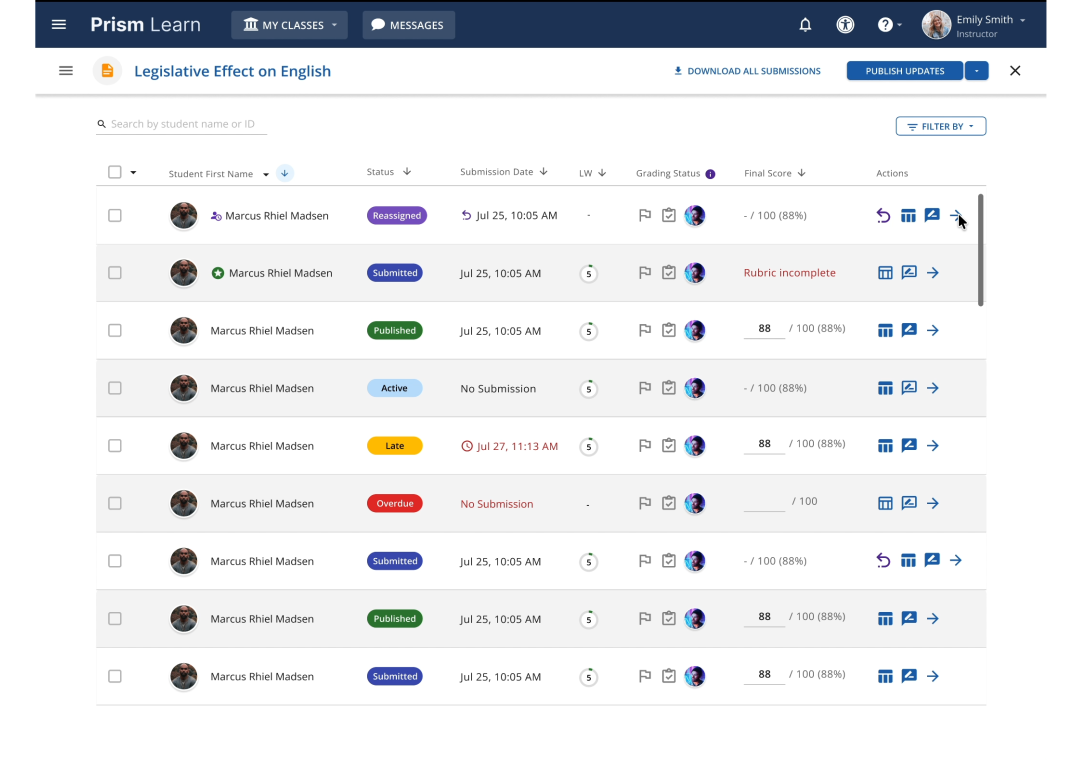
Instructors also had no reliable way to tell which submission was the latest after multiple resubmissions.
Research
Balancing User Needs with Academic Constraints
To understand both instructional and operational perspectives, I interviewed instructors and collaborated with school administrators. The research revealed three stakeholder needs that shaped the redesign.
Instructors
Recover accidental reassignment
Identify the latest submission
Track grading history
Students
Understand reassignment status
Know what to resubmit
University
Preserve academic integrity
Reduce manual coordination
Prevent grading errors
These findings shaped three key design decisions.
Key decisions
Making reassignment recoverable and transparent.
Decision #1
Reversible Reassignment
Problem
Previously, reassignment was a one-time action with no way to revise a submitted decision.
Design decision
I added Undo and Edit functionality, along with confirmation states to prevent accidental changes. Instructors could now correct mistakes without manual follow-ups. They can easily take the action on the list level and in the grading details view.

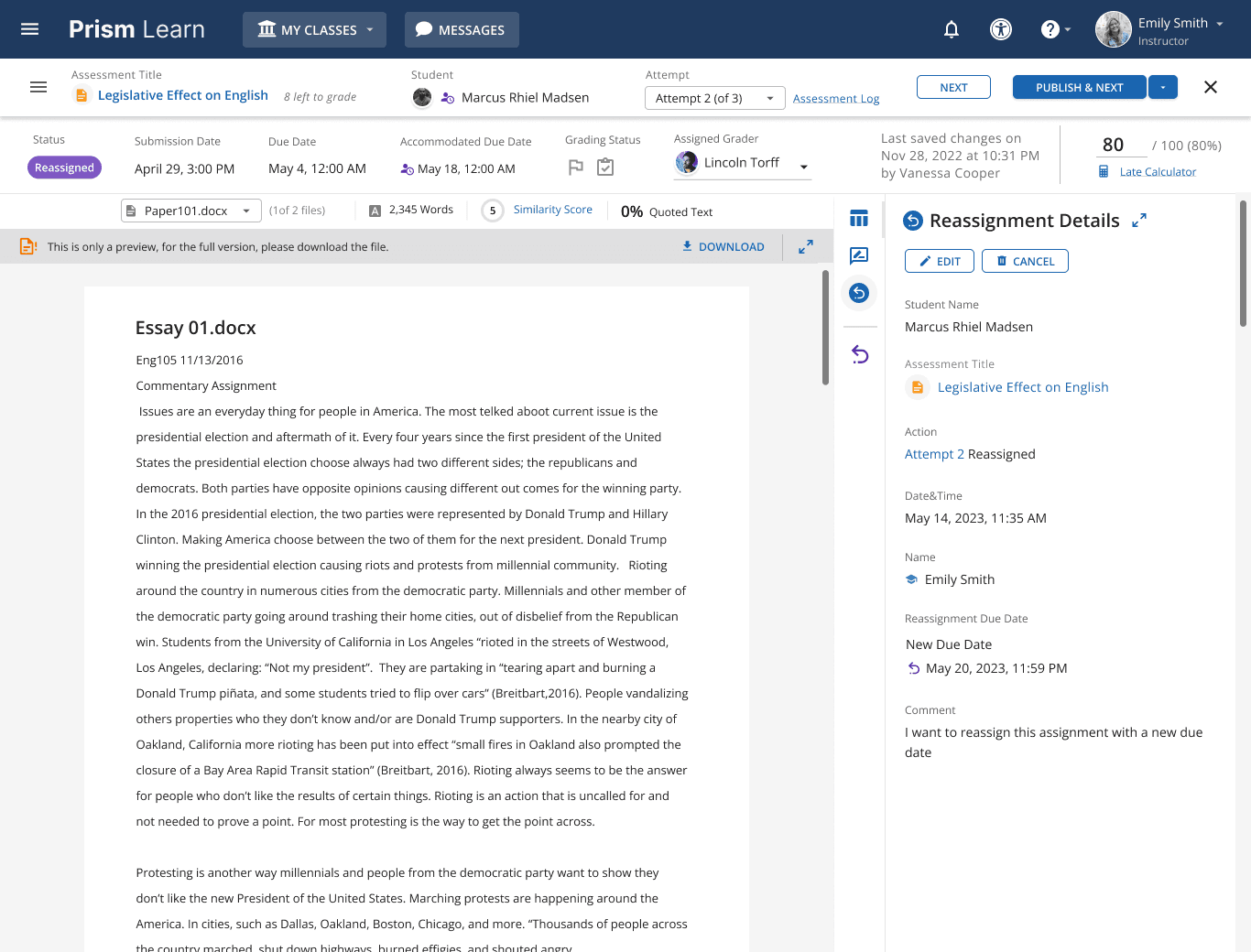
Instructor view: editing a reassignment decision after submission
Decision #2
Make Grading History Explainable
Problem
Once an assessment was reassigned, edited, or canceled, sometimes multiple times with different due dates for accommodated students, instructors couldn't reconstruct what actually happened.

Before: Attempt history log showing one line per attempt. Only shows the latest status, not the sequence of events that led there.
Design decision
I replaced it with a structured log that treats every reassignment as a single source of truth.
The full log records every system action, instructor edit, and student request in order.
A dedicated Reassignment History view surfaces just the reassignment events, so instructors can find what changed without scrolling through the full history.

Instructor view: The whole assessment history view

Instructor view: Dedicated Reassignment History
Decision #3
Simplify Student Resubmission
Problem
Students needed to contact instructors by email or in person to request a reassignment.
Design Decision
I added a reassignment request area in the student's assessment details page.
Allow students to resubmit their assessment without instructor intervention before the due date.
A resubmission closes automatically before the due date if the assessment is ungraded. After the due date, or once grading has started, the request routes to the instructor instead.

Student view: requesting a resubmission from the assessment details page
Outcome
The redesign reduced manual coordination across the reassignment workflow.
35%
Reduced instructor clarification requests. Based on support tickets and PM review.
139k+ users
Platform scale
133k students + 6k faculty
Reduced
Manual backend interventions
Through automated approval routing and a shared reassignment log.
looking back
What I Learned
Lesson 1
Design for clear system state at every step.
Academic policies and grading rules couldn't be simplified, so the interface needed to make every state transition explicit and traceable. Users were more confident when they understood what happened and why.
Lesson 2
Recovery matters more than getting it right the first time.
Instead of blocking every possible error, allowing instructors to undo or edit reassignment decisions reduced more friction. Making actions reversible proved more valuable than adding increasingly complex validation rules.